

My ambition is to make programs that can attract more young people
It is Easter. I remember the wonderful long-standing tradition of the Hungarian Cultural Institute /HCI/ - inviting the general public, and especially the children, to paint Easter eggs according to the Hungarian folk tradition. I am sharing this at the beginning of our conversation with Mrs. Györgyi Dimitrov, at which replies with a smile: "Oh this year, unfortunately, this did not happen because the difference in the dates of the Hungarian and the Bulgarian Easter was very big. And the meaning was lost". But so many other things are done here...
Exactly one year ago - on the 1st of May, 2015, Mrs. Györgyi Dimitrov was appointed director of the Hungarian Cultural Institute in Sofia. But she has been working in this institution for over 8 years and of course, she knows it profoundly. Moreover, during the period 2010 - 2011, she was its director. We have known her for a long time and therefore it is not surprising that the conversation with her was flowing gently and that she knows perfectly Bulgarian as well as the Bulgarian culture and the history of the cultural relations between Bulgaria and Hungary...
- Mrs. Dimitrov, since you have become a Director of HCI, a series of vivid cultural events, seen by the Bulgarian society, were held. What is your assessment of those achievements?
- The emphasis in our program during that time fell on the October events last year, which were also linked to the anniversary of the great Hungarian poet Laszlo Nagy. We started preparing them, of course, together with our local partners, since spring because it had many activities, accompanied by many guests and delegations from Hungary: the Union of the Hungarian writers, the Hungarian Academy of Arts and others. Here was the Deputy Director General of the Institute Balashi, here was also the son of our great poet Laszlo Nagy - Andras. As a result of the visit, a cooperation agreement between the two unions of writers - the Bulgarian and the Hungarian ones, was signed. There were official meetings such as that of Dr. Tamas Kucera - Secretary General of the Hungarian Academy of Arts in Hungary and our ambassador - H.E. Mr. Andras Klein in the Ministry of Culture of Bulgaria. There we talked about what common programs we can have within the cultural agreement between the two countries that was signed in April 2013 for three years, which is to be updated with new concrete ideas.
- The most important thing in the October events for which you speak, was the celebration of the 90thanniversary of the famous poet, translator, publicist and graphic Laszlo Nagy...
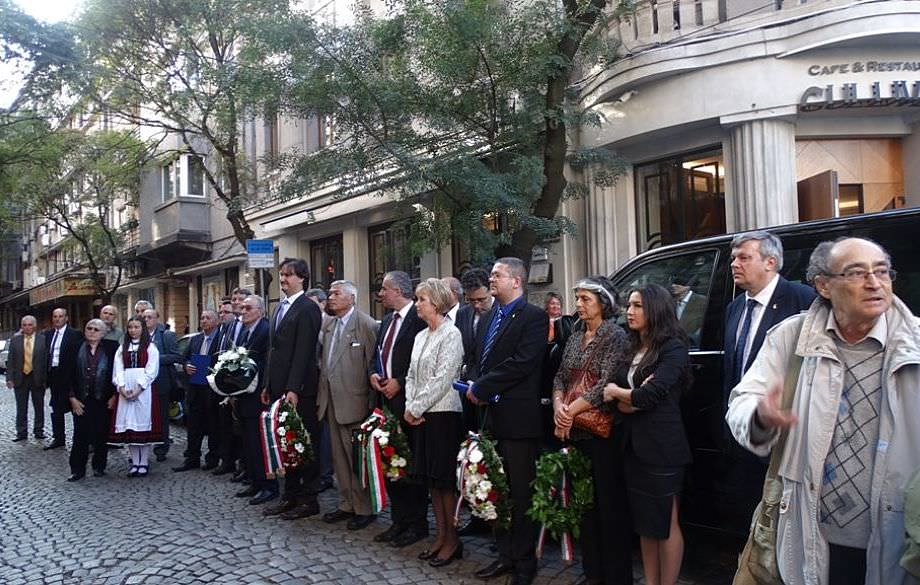
- Yes. So we started with laying of wreaths at his monument, which is on a wall of HCI in Sofia. Here, welcoming words uttered the Hungarian Ambassador H.E. Mr. Andras Klein and the Deputy Minister of Culture Prof. Dr. Boni Petrunova. The event was attended by the Deputy Mayor of Sofia responsible for the "Culture, education, sport and prevention of addictions" Dr. Todor Chobanov. Then a memorial evening with a rich program dedicated to the poet was held. Moreover, in June the HCI announced a translation contest on the verses of Laszlo Nagy in two categories: for high school students and university students. Many children and young people took part, and the results and eight awards were announced and handed at the memorial evening.
The next day we moved to Smolyan, where a bust of Laszlo Nagy was officially placed in front of the library of the city. It is the first of the so-called "Walk of Fame" that the rulers of the city want to create. Its opening was accompanied by a cultural program - children recited verses from the poet and the famous singer Valya Balkanska performed. In Smolyan we also opened an exhibition of Bulgarian artists who had painted the poet orlandscapes related to him. For example, there was a picture of his house in the village of FelshyoIskaz, Hungary.
- The poet is strongly linked with Bulgaria and in particular with Smolyan...
- Since a very young age, Laszlo Nagy came to Bulgaria with a scholarship to study Bulgarian literature. And since he liked the Bulgarian language a lot, he learned it very well. He spent a lot of time in Smolyan. The people there called him and still call him the "Hungarian of the Rhodope Mountains". He learned the local dialect and became the best translator of the Bulgarian folklore in Hungarian. This is his relationship with Bulgaria. The last time he came here was around 1977. Beingin love with the Smolyan region, he wanted to buy a house there, but that was unsuccessful because shortly thereafter he died too young in 1978. Because of this desire, which he had failed to realize, the people of Smolyan donated a very nice Rhodope house in the area "Raykovtsi" as a house-museum of "Laszlo Nagy." Unfortunately, currently it cannot be visited because its roof leak, and its exhibits were moved to the Regional History Museum "Stoyu Shishkov". Some of them we used for the exhibition, which opened on the occasion of the anniversary of the poet. We finished the event in Smolyan with the presentation of the new collection of poems by Laszlo Nagy - "Do Not Explain Miracles, Do Miracles" by the publishing house "Face Press." Its compilers are Pavel Slavianski and Dr. Tosho Donchev.
- Why isn’t the house-museum "Laszlo Nagy" restored?
- When I visited Smolyan, I wanted to make expertise to see what can be done. The amount needed for repair is very high. The Smolyan Municipality is unable to provide that. The house is also not a Hungarian property. It is a property of the Ministry of Culture of Bulgaria and has the status of a monument of local importance. And to find money for a project it must have the status of a monument of national importance. If Smolyan Municipality initiated an action and we, as a Hungarian state support it, then the Ministry of Culture could give it a higher status. We talked about this with the Deputy Minister of Culture and we now have the clarity of what to do. Only after restoring the house, we can return the exhibits in it and it can function not only as a museum but as a place to collect the community that loves literature. And in the agreement for cultural cooperation between our countries there is a point to finance the exchange of writers and translators so that it can be used as a base in which Hungarian guests can stay.
- In 2016, Hungary celebrates 60 years since the revolution in 1956. What have you planned on this occasion?
- There will be a number of major events around the world, including Bulgaria. The highlight here will be the presentation of a modern ballet troupe from the town Szeged with the show "Ritual", which will be at the Sofia Opera and Ballet on the 23rd of October - the day of the outbreak of the revolution. On the 25th of October, the troupe will have a show in Plovdiv. This is a very important for us city, not only because it has a great interest in the Hungarian culture, but also because it will be the European Capital of Culture in 2019. So many events that are meant to be done in Sofia will be exported in Plovdiv, as well. And a wider audience will be able to touch them.
And we will spend a whole day dedicated to the remembrance of the historical events of the 1956. The highlights will be the presentation of the Plovdiv poet Jordan Ruskov, who died several years ago. In 1956 he wrote a poem about the Hungarian revolution and he was therefore thrown into prison, where he lied for whole seven years. The poet has issued a documentary book - "Flowers of Evil", in which this poem was published. We will invite students so we can all together make a memorable evening for him. I would like to remind that in 2013 a memorial plaque was opened in his honour on the fence of the Hungarian embassy in Sofia.
Together with the lecturer of the Hungarian language specialty we will prepare a lecture of our professor-historian with regards to the events in Hungary during 1956.
- There is one more accent in your program - 25 years since the founding of the Visegrad Fund...
- Yes. In this case, we work with colleagues from the Czech Centre, the Polish Institute and the culture attaché of the Slovakian Embassy. In April was one of our joint programs for the celebration of this anniversary – the Visegrad Film Festival. There were presented films from four countries of the Visegrad Fund, from the Hungarian side the movie "Life after Death" was showed, directed by Virag Zomborats.
- You also strive to save all the traditional events that the HCI organises annually...
- Yes, and I'll start with the piano competition named after Franz Liszt and Bela Bartok. It was last held in December. The emphasis on it was the work of Bartok, when we marked the 70 years from his death. Our partner for this contest is the National Music Academy "Prof. Pancho Vladigerov ". This year 135 years of the birth of this great Hungarian composer are marked. We dedicate a number of concert son this anniversary. The first ones have already passed with great success in March. This was a tour of famous Hungarian and Bulgarian musicians in eight cities of Bulgaria under the heading "Danube Brotherhood". Partner in the organization of the Bulgarian side was the virtuoso of the kaval - Mr. Theodosii Spasov.
In April, with a record number of participants and great interest the XXV anniversary edition of Shumen reciting competition for Hungarian and Bulgarian literature was held. This year's edition was dedicated to the 90th anniversary of Laszlo Nagy and the 100th anniversary from the birth of the great Shumen poet Ivan Peychev. This is one of the important events in the Bulgarian cultural life, which is being organized by the Hungarian Cultural Institute in cooperation with the Municipality of Shumen and the Ministry of Culture of Bulgaria since 1969. Initially it was held once a year and later - every two years. The reciting contest is a unique literary event in Bulgaria and because of its uniqueness it is particularly important with regards to the Hungarian cultural diplomacy. It is assumed that the first Bulgarian theatre performance in 1849 was organized under the influence of the Koshutovo emigration in Shumen, while the writing of the first Bulgarian drama is related to the stay of the Hungarians in this city. The reciting competition for Hungarian and Bulgarian literature pays homage to this particular tradition.
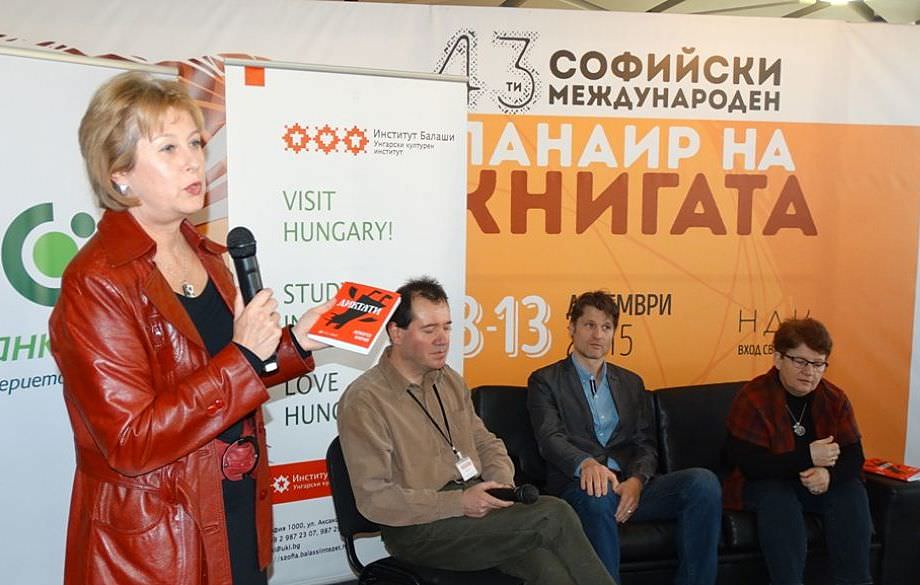
Every year we participate with a stand at the Sofia International Book Fair at the National Palace of Culture. In 2013 we were an honoured country at the fair, but I can say that our presence is always serious. Last year we invited six Hungarian writers to present their work. They left 13 books, translated into Bulgarian, two of which were science- themed. The organizers of the fair say that Hungary has always been a very strong participant and we will try to continue that.
We also take part in the International Jazz Festival in Bansko. For the 2016 edition we have invited the Hungarian group "Pankastic!".
In HCI in Sofia we continue the tradition of opening exhibitions from various genres of modern art. One of them this year will be dedicated to the 100th anniversary of the Hungarian animation that will open in May and will be accompanied by a screening of animated films. We will present the Festival "Golden Kuker" which will be held from the 9th to the 14th of May in Sofia.
- What new can we expect this year?
- One initial endeavour of mine- the staging of the play by the Hungarian playwright Zsolt Pozhgai - "Gina and Fidel" on the stage of the Satire Theatre in Sofia. It will be implemented with the assistance of its director Mr. Zdravko Mitkov. I will try to revive the tradition of HCI to introduce the Bulgarian audience with the achievements of the modern Hungarian theatre.
- What is the situation with the learning of Hungarian language in our country? Is there interest among young Bulgarians?
- Thank God – yes; although rare languages are not preferred. The Hungarian philology at Sofia University has a great history - over 30 years. Before the changes, the interest of Bulgarians towards the Hungarian language was more because the Hungarian culture was something more "advanced" to them. While after the fall of the Iron Curtain when traveling and teaching in the West and America became possible, the importance of the Hungarian language and culture had diminished somehow. Recently, however, we notice that the interest began to rise. The reason for this is that more and more Hungarian companies are coming to Bulgaria and therefore they are seeking for people to work with Hungarian. We very much respect these young people choosing to study our language at Sofia University; we invite them to meetings in the HCI, holidays, film screenings...
In the Shumen University Hungarian language is also studied, this autumn we will have a new lecturer there. For us, this town is very important, it is not accidental that we call it the "Hungarian cultural capital" in Bulgaria. There are monuments associated with the Hungarian presence in Shumen and every year we visit it several times with different cultural events.
- What is your ambition as a director of the HCI?
- To attract more young people with the variety of programs because they are the future.
|
|
Photos: personal archive
- Mrs. Györgyi Dimitrov during the commemoration of the 90th anniversary of the Hungarian poet Laszlo Nagy in front of his monument on the wall of UCI in Sofia
- At the last Sofia International Book Fair at the National Palace of Culture, held in December 2015
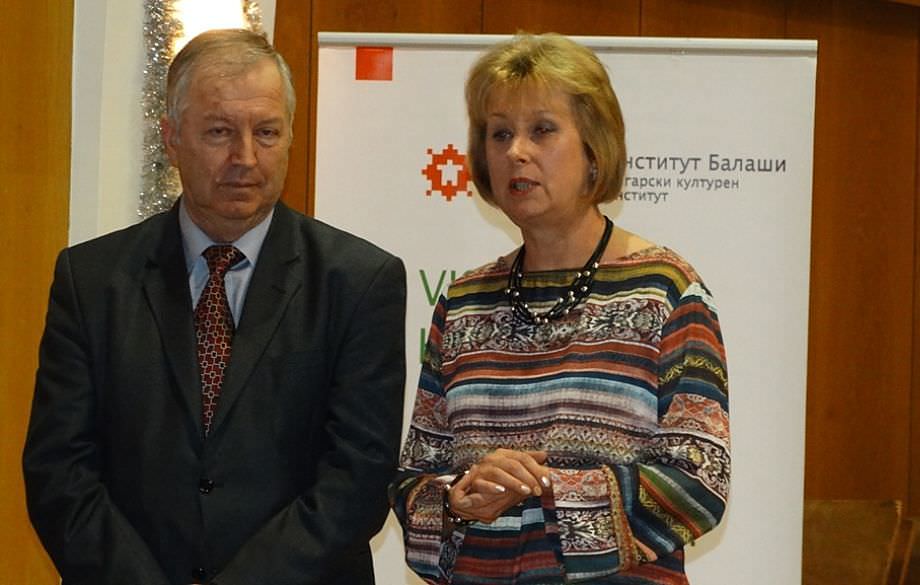
- With prof. Dr. Dimitar Momchilov, Rector of the National Music Academy "Prof. Pancho Vladigerov"
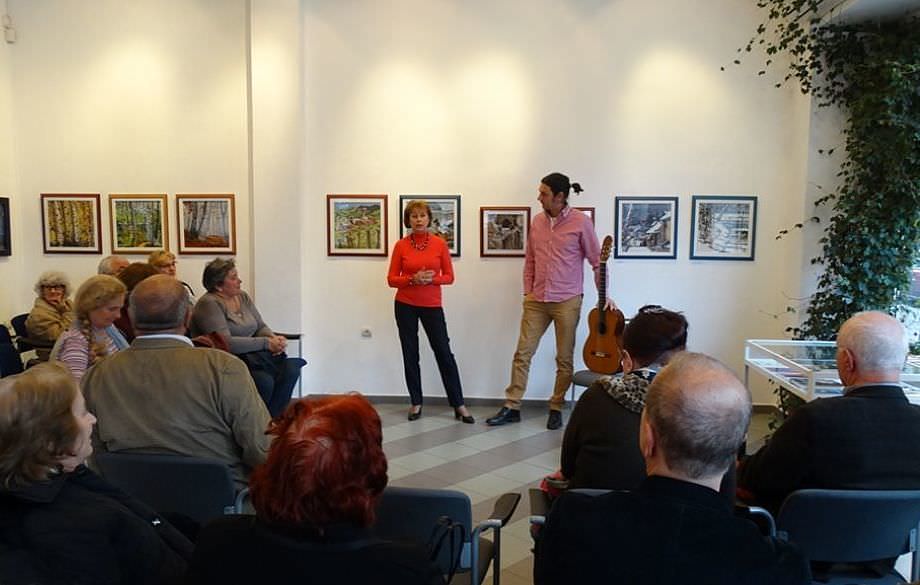
- At the concert of Sandor Meshter /guitar/


